
The remarkable story of a Killarney woman who risked her life to save Allied airmen during the Second World War, and the genealogical research that brought her story back to light.
Janie McCarthy
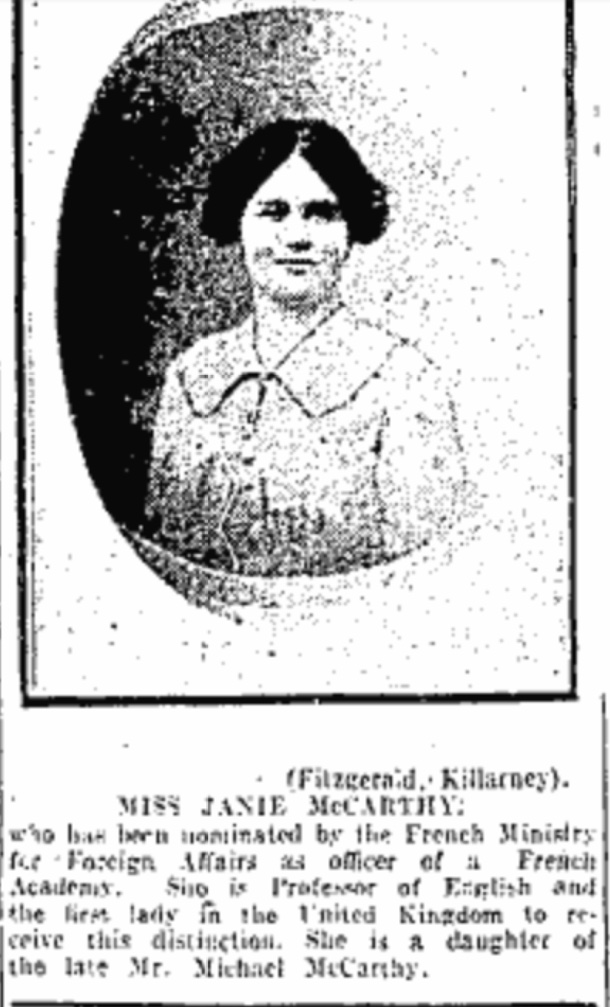
Sometimes an extraordinary story begins with a simple question.
For me, the story of Janie McCarthy began when a local councillor in Killarney appealed on Radio Kerry, asking whether anyone could shed more light on a remarkable local woman who had been honoured by three countries for her work during the Second World War, yet remained largely unknown in her own hometown.
Janie McCarthy was a native of Killarney who had played a courageous role in the French Resistance, helping Allied airmen and other personnel escape from Nazi-occupied France. Her story was extraordinary, but there was surprisingly little detailed information readily available.
I decided to investigate.
Having undertaken genealogical studies at University College Cork, where I researched Janie for my dissertation, I knew that the answers would not necessarily be found online. I began writing to municipal archives and historical repositories in different towns in France, following documentary clues and piecing together the story of a woman whose life had taken her from Kerry to Brittany and eventually to occupied Paris.
What began as an appeal for information became a fascinating journey of historical and genealogical discovery.
From Killarney to Brittany: The beginning of Janie’s French story
Janie McCarthy left Ireland for France in 1910, initially going to Brittany, where she lived with a family and taught English.
One of the most rewarding parts of my research was discovering advertisements Janie herself had placed in local French newspapers, offering her English teaching services. I located these in the newspaper archives, and they provided wonderful little windows into her early life in France.
These were not simply dry historical records. They gave me a glimpse of a young Irish woman making her way in a foreign country, establishing herself through her education, initiative and ability to teach.
I also traced her work at a school in the Breton town of Vannes, where she taught for many years. Her teaching career became an important part of her identity, and she developed a reputation that would eventually bring her into contact with influential families and students from across Europe.
It is remarkable to think that this young woman from Killarney, who had travelled to France with so much of her life still ahead of her, would eventually become involved in one of the most dangerous underground movements of the twentieth century.
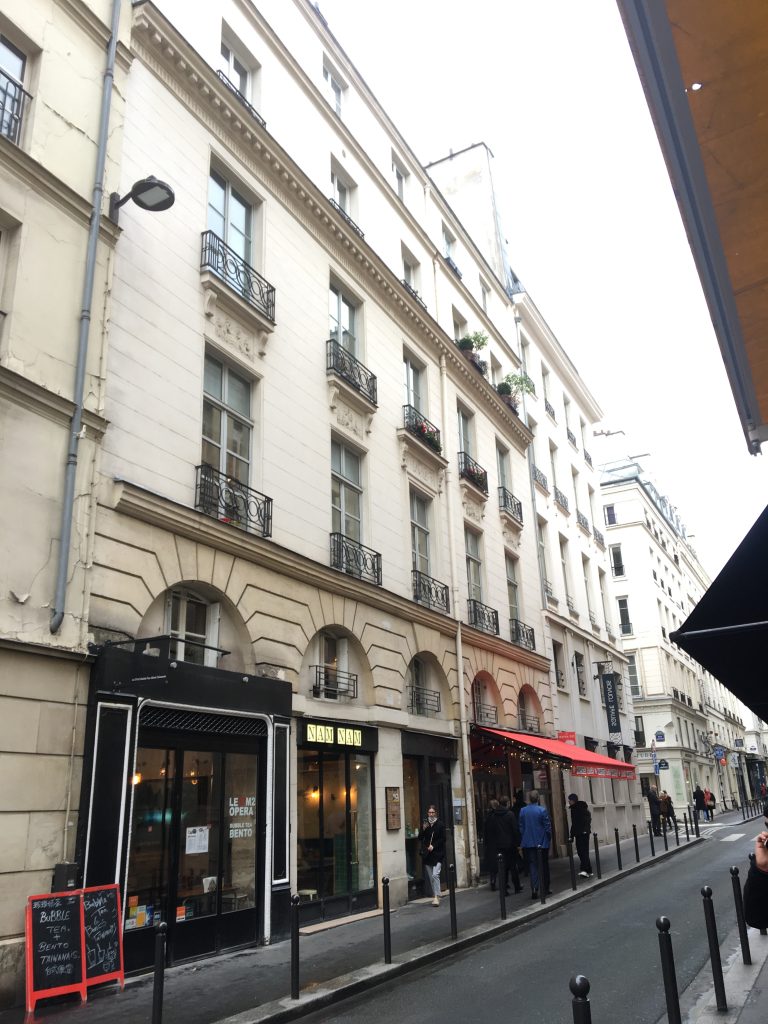
A Remarkable Connection: Janie McCarthy and the Sorbonne
There was another discovery during my research that brought Janie’s story particularly close to home.
It had been written in several accounts that Janie studied History and French at the Sorbonne University in Paris. Rather than simply repeating this information, I decided to contact the university archives to establish exactly what she had studied.
What I discovered was quite extraordinary.
The archival records revealed that Janie had undertaken the course Langue et civilisation française – French Language and Civilisation. It was the very same course that I had studied myself at the Sorbonne.
I found this coincidence particularly moving. Janie and I had attended the same university, studied the same course and spent time in the same part of Paris, although separated by approximately sixty years.
Janie had lived in a small room beneath the roof of a Parisian apartment building, known as a chambre de bonne. These modest rooms were traditionally intended for the servants working for the families who occupied the apartments below.
During my own time in Paris, when I worked as an au pair, I lived in a very similar room. I knew the neighbourhood, the streets and the daily rhythms of that part of the city.
I often think about how Janie and I must have walked many of the same streets, passed the same buildings and experienced the same corner of Paris, separated by six decades but connected by an almost astonishing series of coincidences.
As a genealogist, I have spent many years piecing together the lives of people through documents, archives and family records. But occasionally, research produces something that feels much more personal.
For me, this was one of those moments. Janie was no longer simply a name in an archive or a remarkable woman whose wartime experiences I was trying to reconstruct. Through these discoveries, I began to feel a much closer connection to the person behind the historical records.
It is one of the reasons her story has remained so important to me.
Paris, the Occupation and the French Resistance
Janie eventually moved to Paris, where she continued her teaching career and became established in the city.
Her home was a small room beneath the attic in a building on rue Sainte-Anne, in the centre of Paris. These rooms were traditionally known as chambres de bonne – literally servants’ rooms – small quarters built beneath the roofs of Parisian apartment buildings for the domestic staff employed by the families living in the apartments below.
This detail has always held a particular interest for me. During my own time working as an au pair in Paris, I lived in a very similar room. I know just how small and modest these spaces could be, and it gives me a rather personal connection to imagining Janie’s everyday life there.
When German forces occupied Paris in 1940, Janie’s life changed dramatically.
Through her friendship with Elisabeth Barbier, one of her former students, she became involved in the French Resistance.
What followed was a remarkable period of courage and quiet determination.
My research traced Janie’s involvement in four different underground Resistance networks. She worked with people whose task was to rescue and guide downed Allied airmen out of occupied France, helping them avoid German capture and make their way towards safety.
The escape routes were complex and extremely dangerous. They depended on a network of safe houses, trusted contacts, false identities and people prepared to risk their own lives to help others.
The journeys could take Allied airmen out of Paris, through Brittany and, on other escape routes, south through France towards Spain and Gibraltar, then a British territory.
Janie’s teaching profession provided an unusual and useful means of helping those in danger. By presenting refugees as members of her teaching staff or students, she could help conceal their true identities and give them a degree of protection.
Her apartment also became a safe house for people involved in the underground networks.
One remarkable account describes how she helped an American officer through a Gestapo inspection in the Paris Metro by passing him off as deaf, because he could not speak French.
It is difficult to imagine the composure and quick thinking required to carry out such an act under the eyes of the German secret police.
The danger behind the escape lines
It is easy, looking back from the safety of the present day, to read about the Resistance and its extraordinary achievements without fully appreciating the danger involved.
For those caught helping Allied personnel escape, the consequences could be brutal. Resistance members were interrogated, tortured, imprisoned, deported to concentration camps and, in some cases, executed.
Janie knew these dangers intimately. Some of her colleagues were arrested and deported, and others were shot. Her own near escapes form some of the most gripping parts of the story I uncovered.
The courage required was extraordinary. These were not people who could openly declare their activities or wear a uniform. They were ordinary people leading seemingly ordinary lives while secretly working against an occupying regime.
Janie continued her work despite the risks, helping Allied airmen escape and contributing to the wider Resistance effort until the liberation of Paris.
For her wartime services, she received recognition from three countries: France, the United States and Britain.
It is extraordinary that a woman who had left a small Kerry town at the beginning of the twentieth century should have become such an important figure in the liberation effort in France.
After the war: A teacher to the very end
Following the war, Janie returned to her teaching and continued to dedicate herself to her pupils.
Her reputation as a teacher was considerable. She had taught children from prominent European families, and former pupils remembered her with great affection.
Despite failing health towards the end of her life, she was determined to continue teaching. In fact, she continued giving lessons from her bedside, determined to complete the school term.
There is something particularly moving about this detail. After everything she had experienced during the war, her dedication to education remained constant.
Janie died on 20 December 1964 at the Hertfordshire British Hospital in Levallois-Perret, just outside Paris. She was buried in the nearby cemetery.
But her final resting place would become the subject of another chapter in my research.
Finding Janie McCarthy’s final resting place
One of the most important discoveries I made during my further research in 2022 concerned what had happened to Janie’s remains.
I began investigating the cemetery records in Levallois-Perret, trying to establish exactly where she had been buried.
I discovered that her original grave had been secured through a ten-year burial concession arranged by a solicitor, Cornelius Healy. In France, certain cemetery concessions are leased for a specified period and must be renewed.
Unfortunately, Janie’s concession was never renewed.
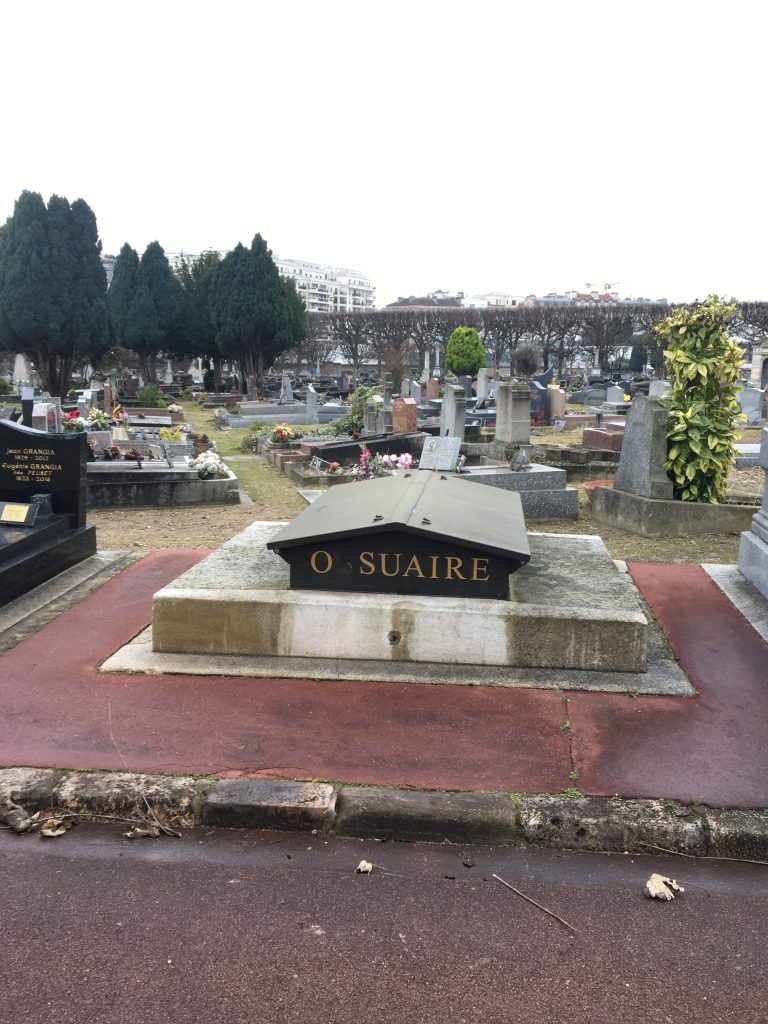
When the ten-year period expired, her remains were exhumed and transferred to a communal ossuary, or ossuaire, where the remains of many other people were placed together.
For a woman who had risked her life saving so many others, the thought that she had ended up in an unmarked communal burial place was deeply upsetting.
I continued my investigation until I was able to locate the ossuary to which her remains had been transferred. I visited the site and photographed it, creating a visual record of the place where Janie now rests. These photographs form an important part of my research archive.
The discovery was reported in the Irish Examiner in July 2022, in an article by Clodagh Finn entitled Solving the puzzle of the wartime heroine buried in an unmarked grave.
For me, this was one of the most significant parts of the entire investigation. It meant that Janie’s story could be told with a much clearer understanding of what had happened to her after her death.
Bringing Janie’s story home to Killarney
One of the things I feel most strongly about is that Janie McCarthy deserved to be remembered in the town where her remarkable life began.
It was difficult to comprehend that someone honoured by France, the United States and Britain had remained relatively unknown in her own community.
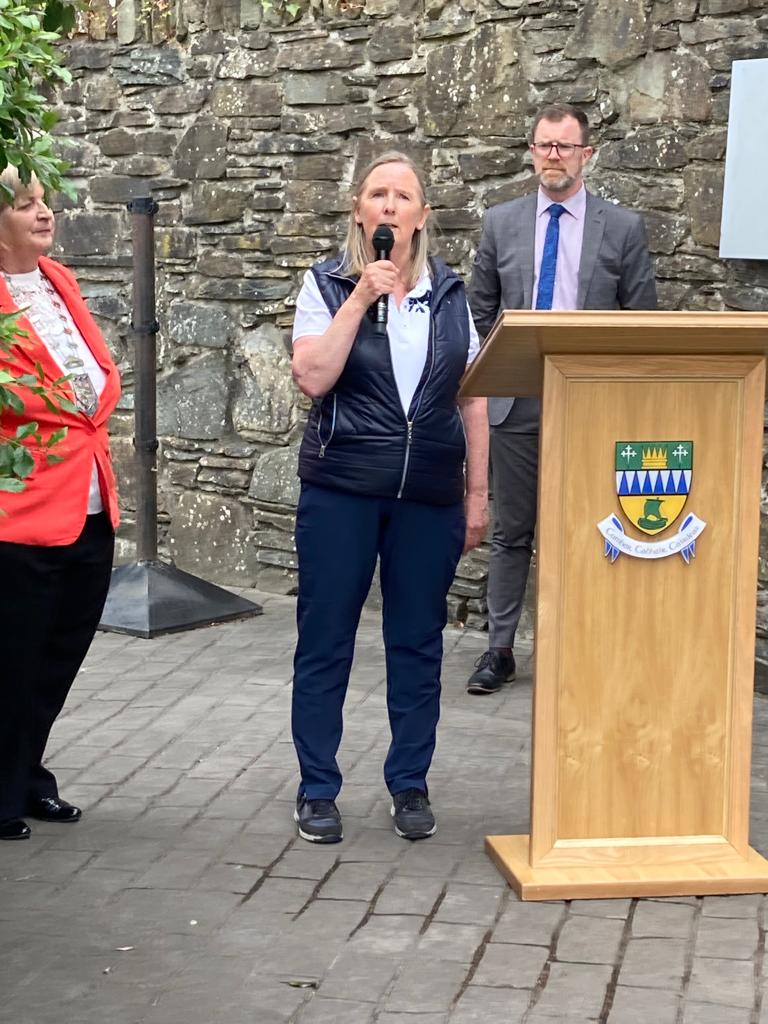
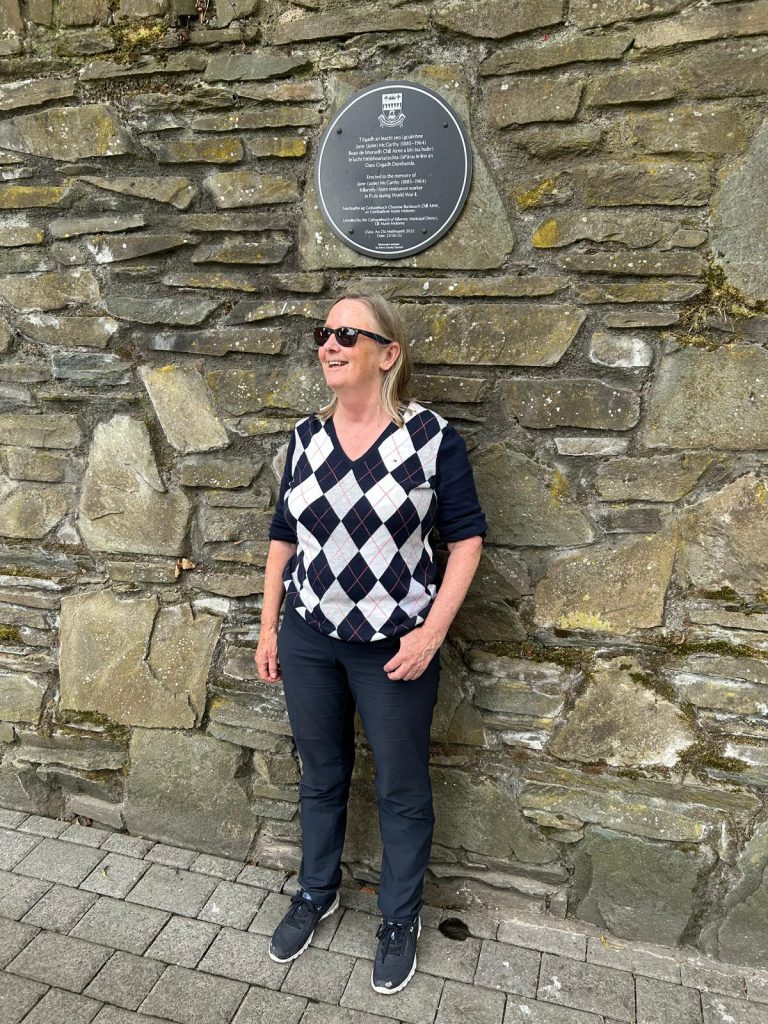
Following local efforts and research, a commemorative plaque was unveiled on Mission Road in Killarney in June 2022.
I was delighted to be part of this recognition. The plaque is situated not far from the monument to Monsignor Hugh O’Flaherty, another Killarney contemporary whose wartime efforts to save lives are remembered with great pride.
There is something particularly fitting about these two Killarney figures being commemorated so close to one another. Both played remarkable roles in helping people whose lives were threatened during the war, and both deserve to be remembered by future generations.
The unveiling was an important moment for Killarney, bringing public recognition to a woman whose courage had long been better known in France and abroad than in her own hometown.
Meeting someone who knew Janie personally
During my research, I was also fortunate to meet Sheila Mulcahy, who had known Janie personally.
Sheila had won a bursary to study in France in the 1940s. When she arrived in Paris, Janie met her at the airport and brought her back to her home.
Through Sheila, I had the opportunity to hear personal memories of Janie that could never be obtained from newspaper accounts or official archives alone.
I made a recording of my conversation with Sheila for the folklore archives at University College Cork, helping to preserve her recollections for future research.
I intend to dedicate a separate article to Sheila’s memories, as I believe her personal testimony adds another very important dimension to Janie’s story.
Genealogist Mary G O’Sullivan at Janie’s plaque
Preserving the story of a remarkable Killarney woman
My research into Janie McCarthy has been one of the most rewarding projects I have undertaken.
It began with my genealogical studies at University College Cork and developed into an extensive investigation involving French archives, historical newspapers, cemetery records and personal testimony.
The additional research I undertook in 2022 brought important new information to light, particularly concerning Janie’s final resting place and the details of her life in France.
I am now preparing my fuller findings for publication with the Kerry Historical Society, of which I am a member. There is considerably more to this story than I can include in one article, and I look forward to sharing the results of that work.
Janie McCarthy was a daughter of Killarney, an accomplished teacher and a courageous member of the French Resistance. She risked her life for people she often barely knew, helping them escape persecution and return to safety.
I hope that by continuing to research and share her story, we can ensure that her name is not forgotten again.
Killarney has many remarkable stories, and Janie McCarthy’s is surely one of the most extraordinary of them all.
 Janie McCarthy French Resistance,
Planning a visit to Killarney?
Discover my Killarney-based tours and experience this spectacular corner of Ireland with Mary G Tours.
If you have any questions about private guided tours or need more information, please feel free to call me. Your adventure in the South West of Ireland awaits!